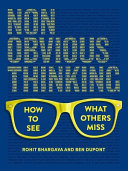
Observational skills are critical in non-obvious thinking. The ability to notice small details and patterns in everyday life can lead to innovative ideas. The author emphasizes that great thinkers are often those who can see beyond the surface. They train themselves to be curious and to question the status quo. This idea highlights that by refining our observational skills, we can uncover insights that others might overlook. The book provides techniques for enhancing these skills, such as journaling observations, engaging in diverse experiences, and practicing mindfulness. By being present and attentive, individuals can develop a richer understanding of their environment, leading to greater creativity and innovative thinking.
Continue readingDiversity in thought and experience is essential for non-obvious thinking. The book argues that when we surround ourselves with people from different backgrounds, we gain access to a wider range of ideas and viewpoints. This diversity can spark creativity and innovation. The author suggests actively seeking out diverse teams and engaging in conversations with those who think differently. By embracing diverse perspectives, we can challenge our assumptions and expand our thinking. The book provides examples of successful companies that have leveraged diversity to drive innovation, demonstrating that inclusivity is not just a moral imperative but also a strategic advantage.
Continue readingCuriosity is a driving force behind non-obvious thinking. The author posits that maintaining a sense of wonder and a desire to learn can lead to breakthroughs in thinking. Curiosity encourages exploration and experimentation, allowing individuals to venture beyond conventional boundaries. The book discusses how cultivating curiosity can be fostered through asking questions, seeking out new experiences, and being open to failure. By nurturing a curious mindset, individuals can discover new opportunities and develop innovative solutions. The author also emphasizes that curiosity should be encouraged in organizational cultures to drive collective innovation.
Continue readingThe ability to challenge assumptions is a cornerstone of non-obvious thinking. The book stresses that many of our beliefs are based on unexamined assumptions that can limit creativity and innovation. The author encourages readers to identify their assumptions and question their validity. Techniques for challenging assumptions include brainstorming alternative scenarios, using 'what if' questions, and engaging in critical thinking exercises. By breaking free from limiting beliefs, individuals and organizations can explore new possibilities and develop unconventional solutions. The book provides case studies that illustrate how challenging assumptions has led to significant breakthroughs in various fields.
Continue readingFor non-obvious thinking to thrive, organizations must foster a culture of innovation. The book outlines the characteristics of innovative cultures, such as psychological safety, collaboration, and a willingness to take risks. The author argues that leaders play a crucial role in shaping this culture by modeling innovative behaviors and encouraging experimentation. Strategies for creating a culture of innovation include rewarding creative ideas, providing resources for exploration, and allowing time for creative thinking. The book highlights examples of companies that have successfully built cultures of innovation, demonstrating that a supportive environment can unleash the creative potential of teams.
Continue readingTechnology serves as both a tool and a catalyst for non-obvious thinking. The author discusses how advancements in technology can enhance our ability to gather information, analyze data, and collaborate with others. However, the book also warns against over-reliance on technology, emphasizing the importance of human creativity and intuition. The author advocates for a balanced approach, where technology is used to augment, rather than replace, human thinking. By leveraging technology effectively, individuals can enhance their non-obvious thinking capabilities and drive innovation in their work.
Continue readingStorytelling is a powerful tool for communicating non-obvious ideas. The book highlights how narratives can help convey complex concepts in an accessible and engaging manner. The author explains that effective storytelling can inspire action, foster empathy, and create connections among people. Techniques for improving storytelling skills include understanding the audience, structuring narratives effectively, and using visuals to enhance the message. By mastering the art of storytelling, individuals can share their innovative ideas more persuasively and influence others to embrace change.
Continue readingThe reading time for Non-Obvious Thinking depends on the reader's pace. However, this concise book summary covers the 7 key ideas from Non-Obvious Thinking, allowing you to quickly understand the main concepts, insights, and practical applications in around 23 min.
Non-Obvious Thinking is definitely worth reading. The book covers essential topics including The Power of Observational Skills, Embracing Diverse Perspectives, The Importance of Curiosity, providing practical insights and actionable advice. Whether you read the full book or our concise summary, Non-Obvious Thinking delivers valuable knowledge that can help you improve your understanding and apply these concepts in your personal or professional life.
Non-Obvious Thinking was written by Ben DuPont, Rohit Bhargava.
If you enjoyed Non-Obvious Thinking by Ben DuPont, Rohit Bhargava and want to explore similar topics or deepen your understanding, we highly recommend these related book summaries:
These books cover related themes, complementary concepts, and will help you build upon the knowledge gained from Non-Obvious Thinking. Each of these summaries provides concise insights that can further enhance your understanding and practical application of the ideas presented in Non-Obvious Thinking.